
Cycle to Success: What can hormones teach us about healthier workplaces?
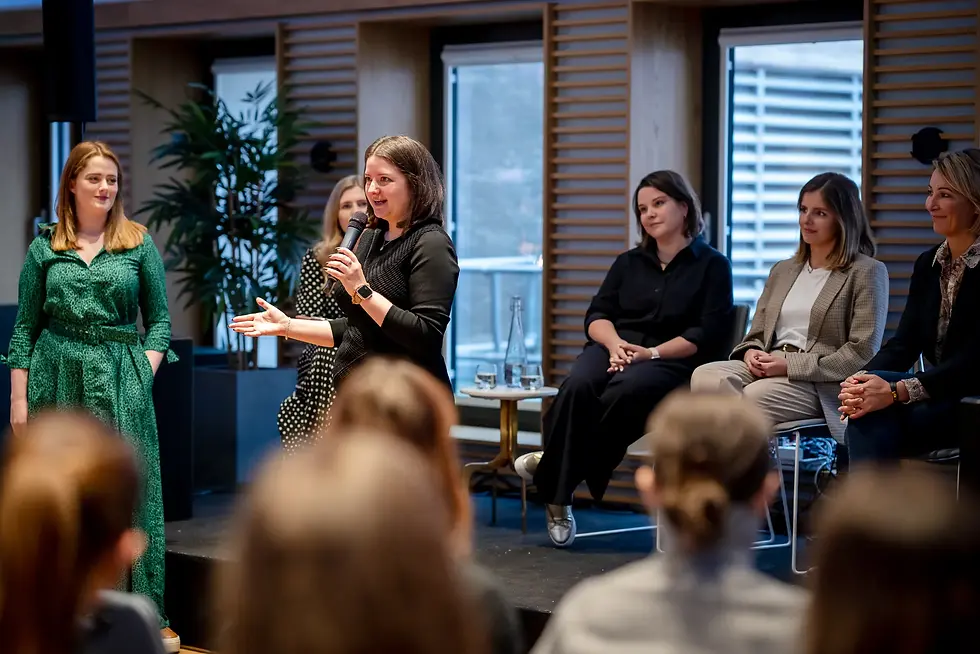
Bloom Scotland recently brought women and, for the first time, men together for Cycle to Success: a candid conversation about hormones, health and working life.
Building on previous panels about periods, menopause and ageism, we explored the thread connecting them all: hormones and how they can affect our energy, mood, sleep, concentration and confidence throughout our lives.
We chose this topic because it goes to the heart of Bloom Scotland’s mission: shining a light on the challenges all women face and removing the barriers that stand in the way of equality. Hormonal health is one of those challenges, and at work it is still too often left unsaid.
The panel combined research, leadership and lived experience: Dr Kathleen Riach, Professor at the University of Glasgow and chair-convenor for the new international workplace standard; Laura Jenkins, Marketing Director at FreeAgent; and Amy Wilson, Account Manager at Republic of Media and personal fitness coach, chaired by Bloom Scotland President Claire Matheson.
Our bodies are dynamic rather than broken
Kathleen challenged the language we often use around hormones. Hormonal changes are too often presented as a female problem to control, hide or push through. Yet everyone has hormones and everyone’s body changes.
A more useful starting point is to see our bodies as dynamic rather than defective. Reframing “What is wrong with me?” as “What is my body telling me, and what would help?” creates space for informed choices and more honest conversations at work.
This was the biggest takeaway of the evening for me. Kathleen invited us to stop treating our hormones as a foe and start getting curious about them instead. Not something to fight. Something to understand, and use for us.
There is no single textbook experience of a menstrual cycle either. The key is to notice our own patterns and work with the energy we have.
Amy uses higher-energy phases for creative and big-picture thinking, then turns to admin when her energy dips. Laura takes a similar approach, scheduling important pitches during higher-energy windows where possible. On lower-confidence days, a bright red blazer and lipstick can provide a small but useful boost.
This is not about building a rigid productivity system around a perfect cycle. It is about understanding what helps.
Kathleen connected this to chronobiology: our natural rhythms, including the 24-hour circadian rhythm and shorter ultradian cycles of energy and focus. Hormonal health extends beyond oestrogen and progesterone. It can also be influenced by sleep, stress and how psychologically safe we feel at work.
Policies matter but managers bring them to life
Another strong theme was the gap between having a policy and feeling supported.
Managers do not need to become hormone experts. They need to listen, ask what would help and find practical solutions. Amy spoke openly about her PMDD diagnosis. Her manager was unfamiliar with the condition, so they learned together. This turned a confusing pattern into something they could anticipate and manage. As Laura put it: “Just because you don’t have a policy doesn’t mean you can’t create an environment which is safe.”
This point felt especially relevant because, just days before the event, ISO 45010 launched as the first international standard offering workplace guidance on menstruation and menopause.
Kathleen, who helped convene its development, explained why hormonal health belongs within health and safety, not only HR. The standard asks organisations to consider how their culture, facilities, working practices and management can better support the people working within them.
At FreeAgent, policies allow people to be open when hormonal symptoms are affecting them. But Laura also emphasised that managers can create safety within their own teams through trust, flexibility and a willingness to talk—even before a formal policy exists.
Hormones affect everyone
Men’s hormonal health was also brought into the conversation.
Age-related testosterone decline is generally more gradual than menopause, and not every midlife symptom is hormonal. However, dismissing physical or emotional changes as a “midlife crisis” can prevent men from seeking support.
Kathleen described how focusing on health, safety and performance helped open up these conversations within male-dominated engineering and construction firms. When hormonal and mental health are treated as everybody’s business, workplaces become safer for everyone.
Redefining success
Everyone’s definition of success can vary day to day, week to week.
For Amy, success begins with self-knowledge. It might mean achieving an ambitious goal one day and taking a walk, having a coffee or starting later on another. Both are valid.
Laura described the loss of confidence she experienced after postnatal depression. Years later, a male colleague told her she was the person he compared himself unfavourably with. It was a powerful reminder that how we feel internally and how others see us can be worlds apart.
The panel also challenged perfectionism. Success does not have to mean meeting the same fixed standard every day. Define what it looks like for you now—because reaching 80% of your goal can still be a win.
What we took away
Pay attention to your own patterns. Your lived experience matters more than generic advice.
Match tasks to your energy where possible.
Make conversations easier. A supportive manager can have an immediate impact.
Treat hormonal health as workplace health.
Keep men in the room. Better understanding benefits everyone.
What stayed with us was the generosity in the room. Panellists and audience members spoke openly about pain, brain fog, body-image wobbles, postnatal depression, PMDD and changing confidence.
There was laughter too, showing that these conversations do not have to feel clinical or heavy.
For me, this was personal. I’m moving through perimenopause into menopause, and the morning of the event was a hard one. Even with HRT, some days my energy and mood have a mind of their own. But I’m glad I made it there. I left with a shift in perspective and a few useful nuggets that have stayed with me.
One event cannot transform how hormones are understood or supported at work. But perhaps Cycle to Success begins here: understanding our bodies, speaking honestly and advocating for greater awareness and stronger policies.
Together, we can create workplaces where everyone can thrive.
Reliable information and further reading


Comments